UNDERSTAND AND MASTER
Classical Mechanics
Below you will find my recommended route for mastering mechanics.
The right way to study
Classical mechanics is the backbone of almost all of physics. Yes, even for quantum mechanics. You need to be absolutely fluent in it. Studying usually starts with introductory physics where elementary concepts are introduced such as Newton’s equations of motion, parabolic trajectories, various forces, kinetic and potential energy, etc. These concepts together with their calculations should feel very comfortable before moving on to the more formal approaches.
As is the case with any subject, you learn it by doing. Do as many exercises as you can, do them again, and then another time. You need to be able to solve these problems in your dreams.
So how much is many? I would recommend doing 50-60% of the exercises of each chapter. You can skip repetitive exercises or exercises that only rely on algebraic manipulation. Derivations are key!
Reading textbooks: Do not rush yourself. Read a chapter, or split it up in chunks if it is too big. Then do the problems for the material you just learned. For classical mechanics I would say that studying from just one book is sufficient. The approach among all books of similar level is more or less the same.
Watching lectures: Please note, lectures alone are NOT enough. Combine these with one of the books. It gives you so much clarification for the parts you did not understand during the lectures. Books also cover much more in higher detail.
Problem sets: Doing the problem sets from only the book is okay, but it is absolutely worth it to try multiple problems from different books, lecture notes, online sources, etc. This removes the writers filter from your way of looking at problems. You need a flexible and wide set of skills. Practising from only one source puts you in a very specific way of solving, which is not always desired. Keep an open mind!
Roadmap:
We start at introductory physics and move our way up from here. The big distinction is between undergraduate CM (give you a flavour of the subject) and graduate (the serious works). Any theoretical phycisist, no matter what field they are in, need to get to the level of graduate CM.
Introductory Classical Mechanics
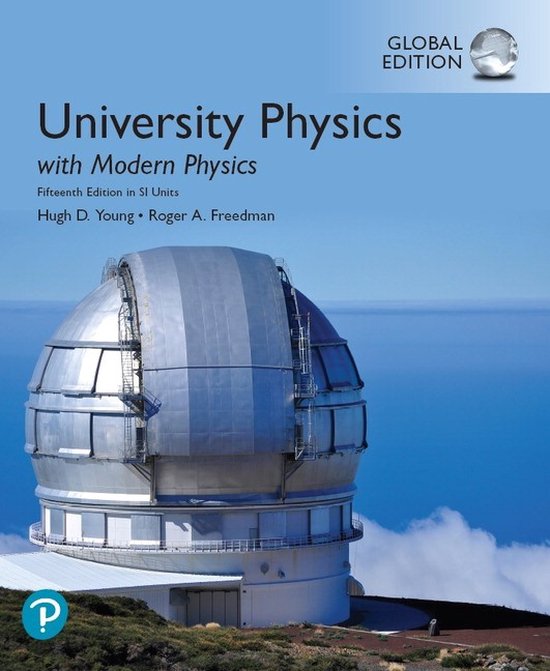
“University Physics” by Young & Freedman
This is a classic for a first exposure to classical mechanics (or physics in general for that matter). This book gives you a solid foundation for further studies. To study from this book the following prerequisites are needed.
- Basic physics knowlegde (high school level)
- Basic algebra and calculus (high school level)
- Anything more than this is just bonus.
As is with all of physics, I will say it again and again, do the exercises! You dont get fit by watching someone work out. Always study actively.
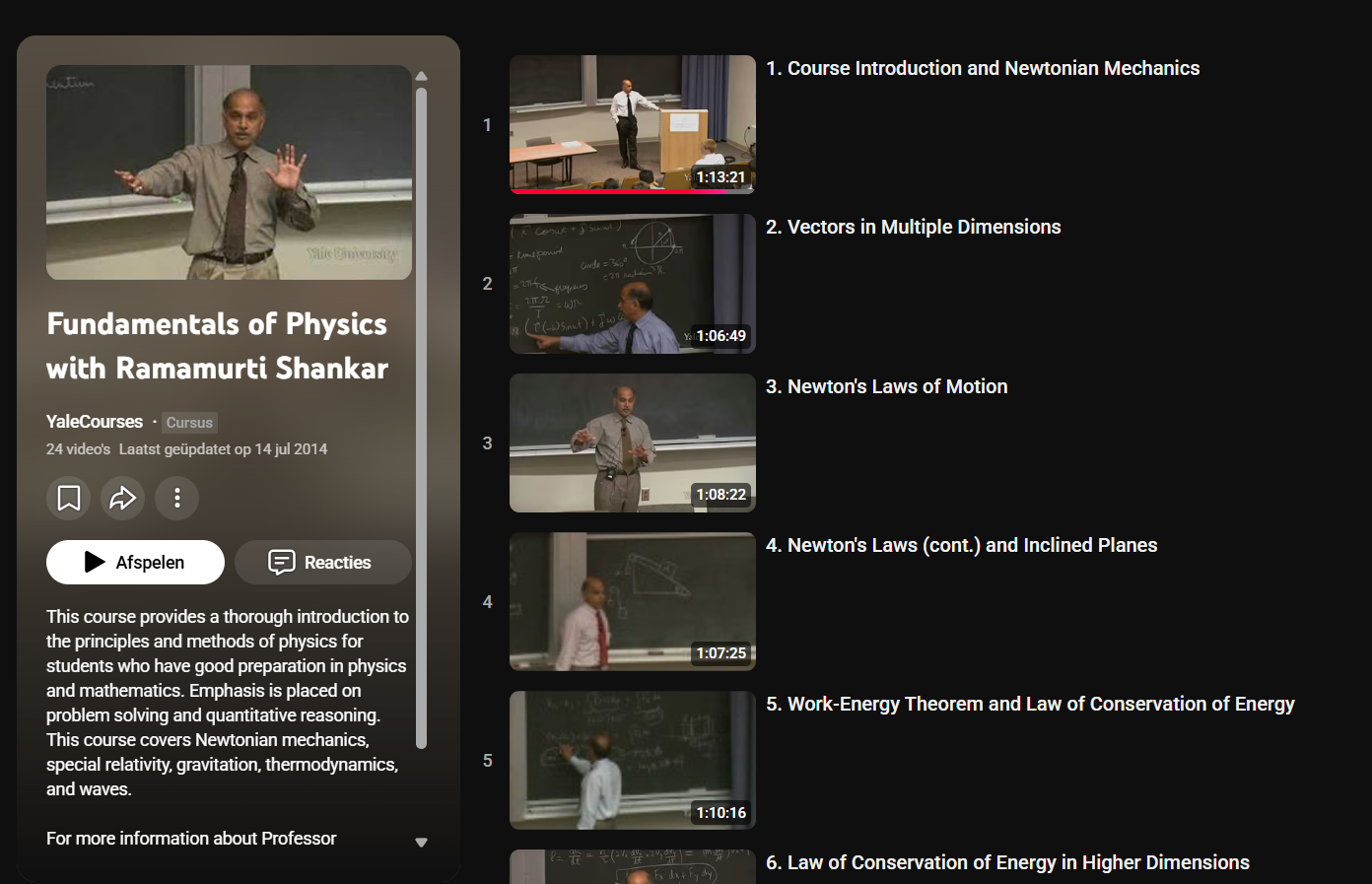
Fundamentals of Physics with Ramamurti Shankar
This is a good lecture series on introductory physics. It does however asumme some calculus. It is a great watch together with an introductory physics book.
Undergraduate Classical Mechanics
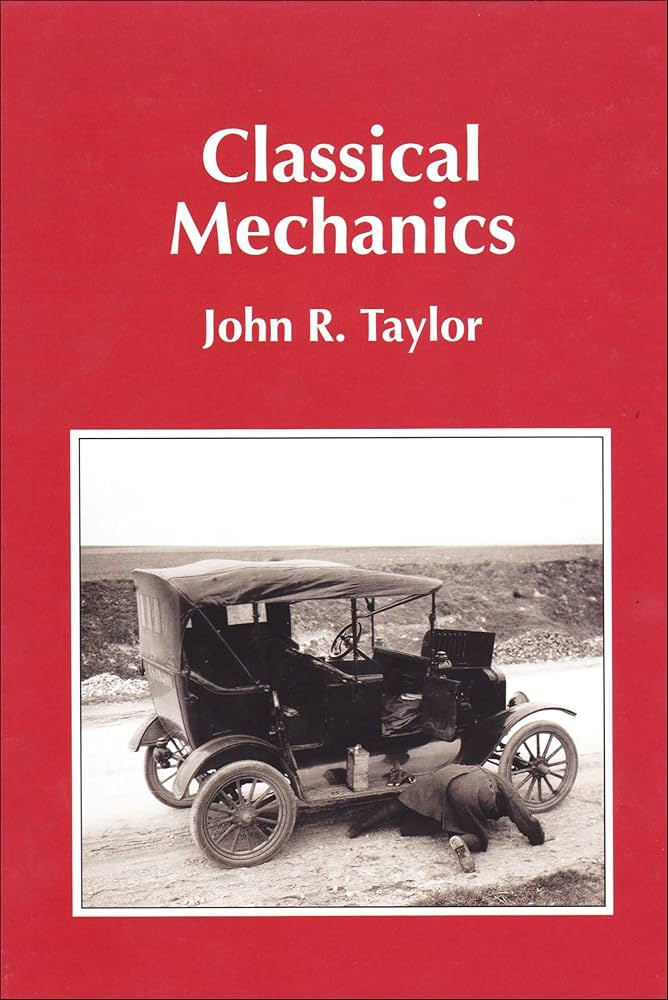
“Classical Mechanics” by Taylor
Now you are ready for your first proper exposure to classical mechanics. Taylor is a widely known textbook used in many universities. Not all chapters are as relevant. I recommend studying the important chapters and coming back to the ‘special topics’ once you feel the need to.
Prereqs:
- Multivariable Calculus
- Vector calculus
- Partial differential equations
- Introductory physics
I would say the following chapters are an absolute must for any serious phycisist.
- Chapter 1 – Newton’s Laws of Motion
- Chapter 3 – Momentum and Angular Momentum
- Chapter 4 – Energy
- Chapter 5 – Oscillations (you could skip it initially but it should be done at some point)
- Chapter 6 – Calculus of Variations (REALLY IMPORTANT)
- Chapter 7 – Lagrange’s equations (REALLY IMPORTANT)
- Chapter 13 – Hamiltonian Mechanics (REALLY IMPORTANT)
All other chapters can be studied at your own interest. The chapter on special relativity is nice for a first exposure, but many other subjects cover this as well. The chapters about Langrangian and Hamiltonian mechanics are the core of all of modern physics. The basic principles are introduced here but you won’t appreciate them until your proper formal exposure.
VIDEO LECTURES:
If you prefer studying from lectures, there are a few great sources.
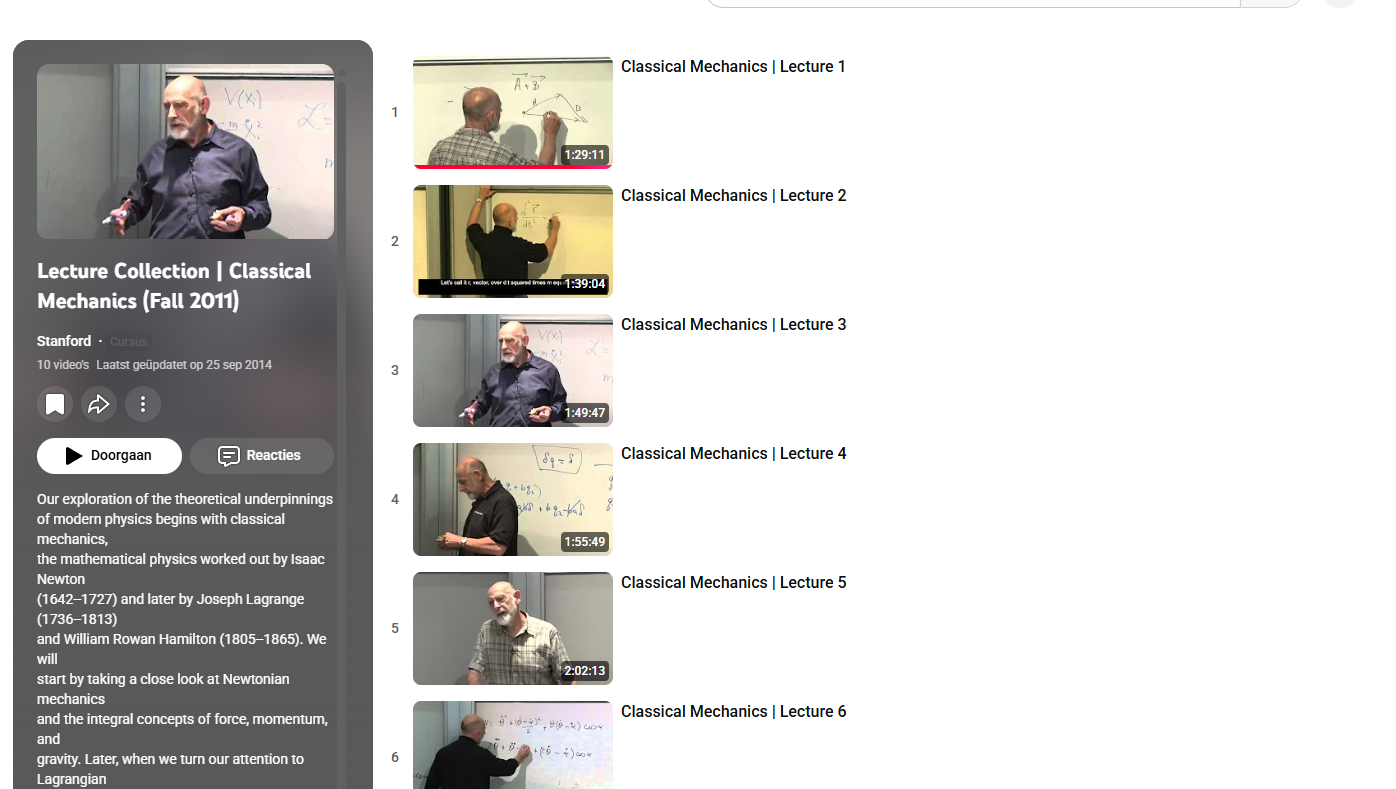
“The Theoretical Minimum – Classical Mechanics” – Leonard Susskind
This is a video series on YouTube of a lecture series given at Stanford. Susskind is a great communicator and phycisist. These lectures should mainly be used for intuition, as they most of the time lack formal derivations and mathematics. Do not be fooled by the simplicity though, the material covered goes quite deep, well beyond a standard undergraduate mechanics course.
The lectures come with a book, having the same name, including some problems.
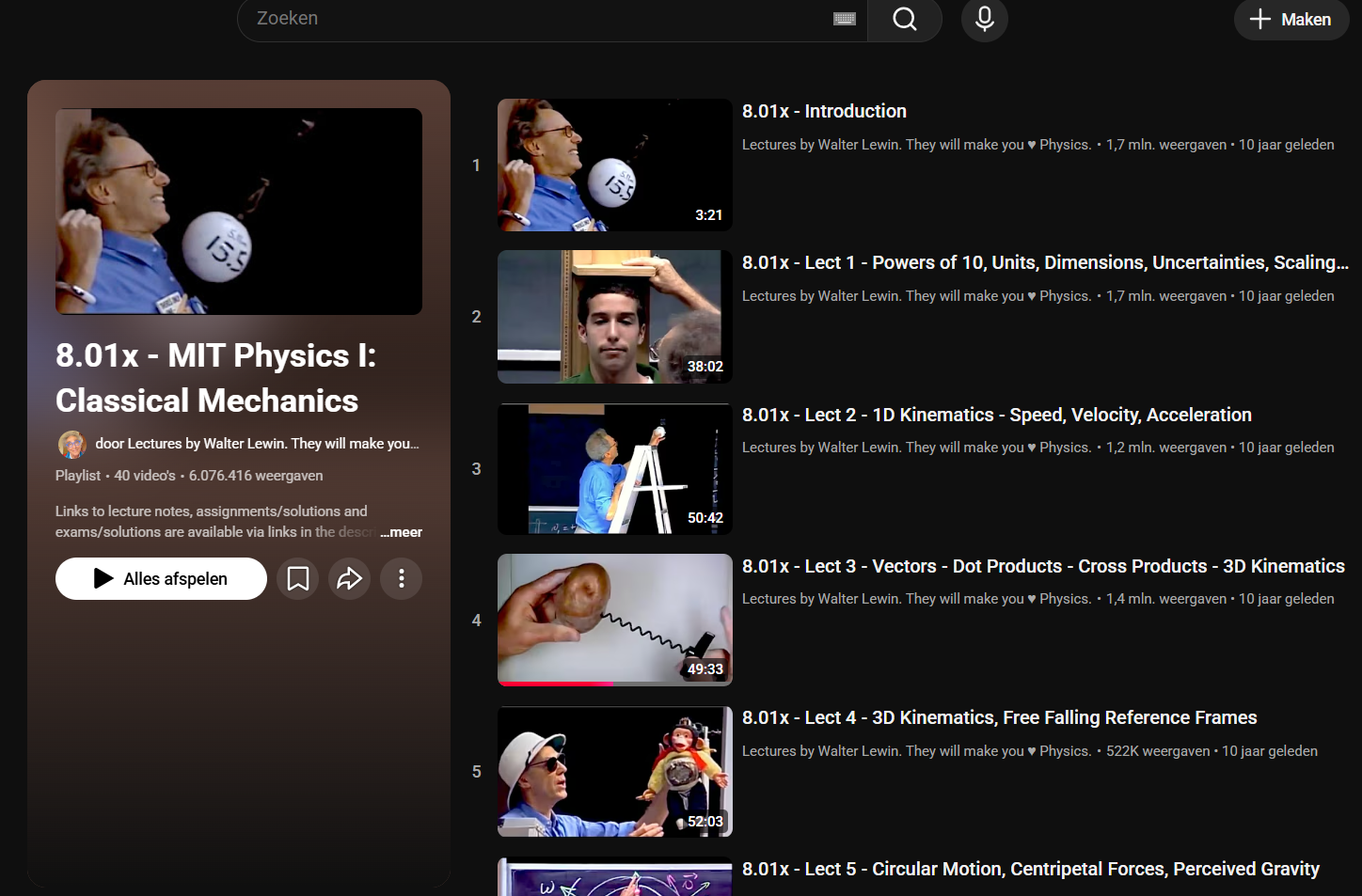
8.01x – MIT Physics I: Classical Mechanics
Walter Lewin is a very passionate teacher who is great at giving deep understanding rather than just doing calculations. The material is rigorous enough for an undergraduate course in mechanics, but still very accesible. All in all it is a very engaging and entertaining watch.
Link to lectures
Graduate Classical Mechanics
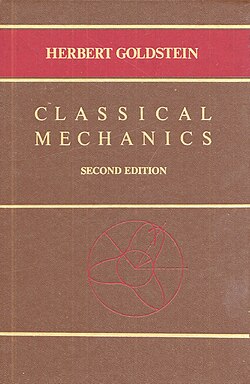
“Classical Mechanics” by Goldstein (2nd edition)
The classic graduate textbook in mechanics. Loads of students struggle with this book, given that it is dense, hard and fast paced. However, if you take your time, it will be one of your most valuable assets in your career.
Goldstein is your proper exposure to formal classical mechanics. It introduces the Lagrangian and Hamiltonian formalism, canonical transformations, gauge transformations, and finally moves on to field theory.
Prereqs:
- Solid calculus foundation
- Solid linear algebra
- Partial differential equations
- Worked through Taylor, or similar works.
I would say the following chapters are an absolute must for any serious phycisist.
- Chapter 1 – Newton’s Laws of Motion
- Chapter 3 – Momentum and Angular Momentum
- Chapter 4 – Energy
- Chapter 5 – Oscillations (you could skip it initially but it should be done at some point)
- Chapter 6 – Calculus of Variations (REALLY IMPORTANT)
- Chapter 7 – Lagrange’s equations (REALLY IMPORTANT)
- Chapter 13 – Hamiltonian Mechanics (REALLY IMPORTANT)
All other chapters can be studied at your own interest. The chapter on special relativity is nice for a first exposure, but many other subjects cover this as well. The chapters about Langrangian and Hamiltonian mechanics are the core of all of modern physics. The basic principles are introduced here but you won’t appreciate them until your proper formal exposure.
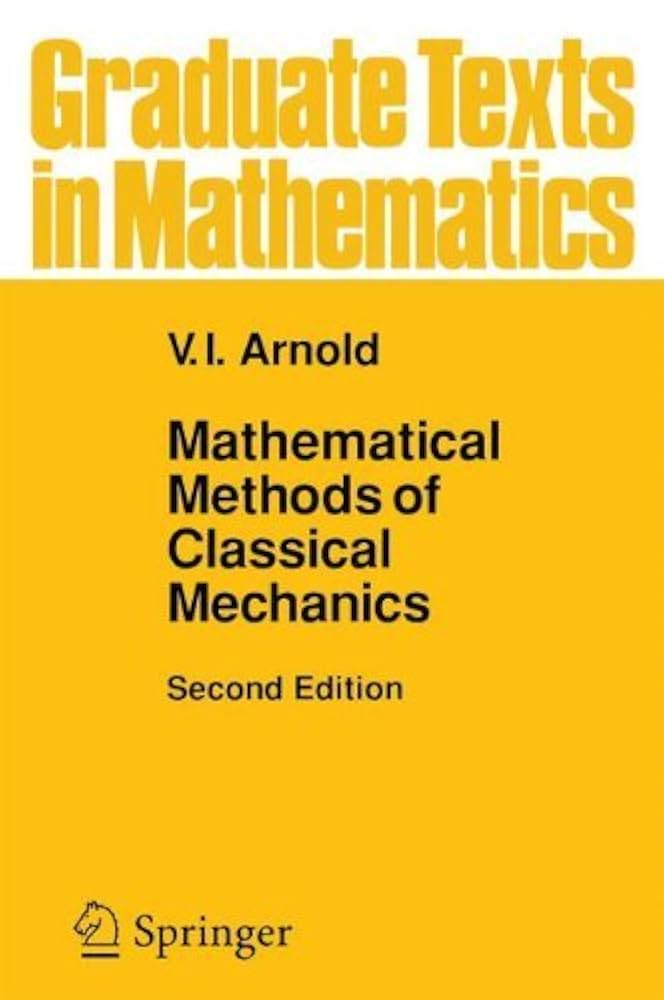
“Mathematical Methods of Classical Mechanics”by V.I. Arnold (2nd edition)
Now that you are well equipped with the fundamentals you can move into rigorous classical mechanics. In most cases this is not a must read, unless you plan to go into mathematical physics. Arnold is a good book on the mathematical structure behind classical mechanics, namely symplectic manifolds.
Suprisingly, the prerequisites for this are minimal, but you are expected to have a certain level of mathematical maturity.
Prereqs:
- Same as for Goldstein
- Mathematical maturity (a class in writing proofs helps)
People use this book as a reference, even for doing research. I would approach this book in a similar way. Do not read it front to back, but focus on the topics that are relevant to you at the moment. Use it to deepen and strengthen your knowlegdge, not widen it.